
I’ve noticed that some new Peace of Mind Spending clients have a tendency to categorize some inflows directly to the category they plan to spend the money on. I can see how that makes sense to them…why not skip the middleman (Ready to Assign) and go directly to the category?
There’s a good reason: It can mess up your how you see your spending.
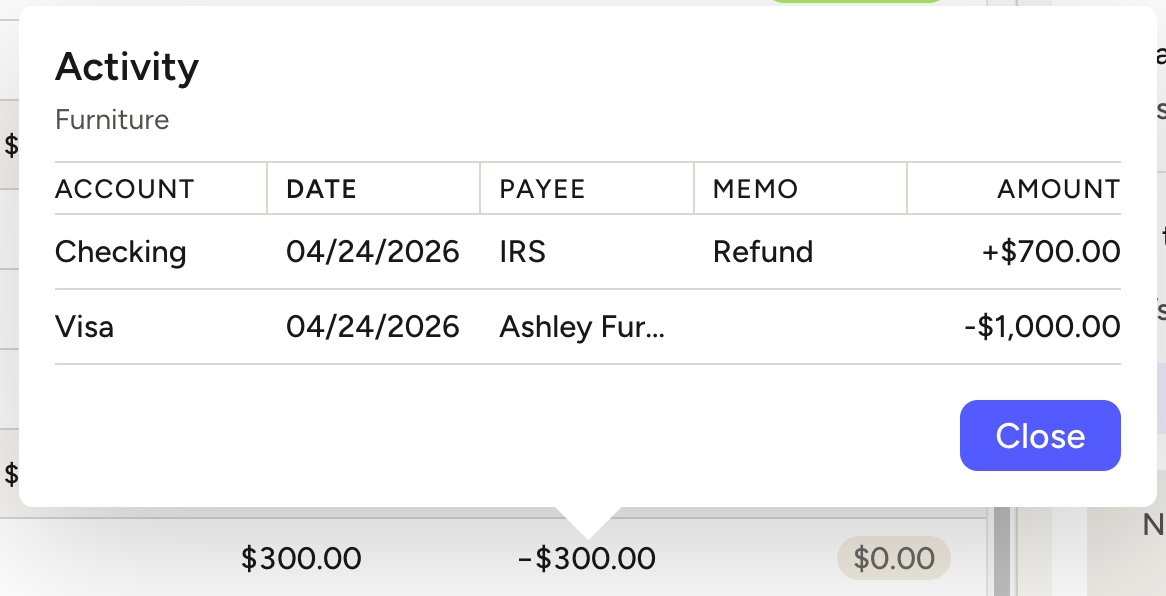
When you categorize an inflow directly to a category (in your account screen), YNAB deducts that amount from your spending in that category. Let’s say you get a $700 tax refund and instead of categorizing it to RTA, you know you want to use it to buy a new couch, so you assign it to the Furniture category. Then you buy a couch for $1000 and categorize the spending to Furniture. You’re overspent by $300 so you move money from another category to cover it.
In your Plan, YNAB will show that you spent $300 on the couch, rather than the $1000 you actually spent.

You know you spent $1000, not $300 on furniture, so you click on the -$300 in the Activity column. Here’s what you see:

The same thing shows up in your reports, if you look at spending in the Furniture category this month.

That’s not accurate. The better thing to do is to categorize the tax refund (and, really, all inflows except reimbursements and returns) as Inflow: Ready to Assign. Then assign the amount to the appropriate category in the Plan. It’s one more (small step) but your Plan will be more accurate and if you ever go back to, your future self will thank you.
If you do the proper way, your category in the Plan will reflect reality:

And when you click on -$1000 in Activity you see this:

And, finally, your spending report for furniture in Reflect is accurate:

Just remember that Inflows should be categorized as Ready to Assign (unless it’s a return or reimbursement), and YNAB will reflect your spending accurately.
Leave a Reply